
Accessibility Benchmarking for Product Roadmapping
Mapping 43 features across five competitors and prioritizing what truly matters for users and compliance.
Project overview
- Company
- Hand Talk
- Date
- Q3 2023
- Scope of work
- UX Research
- Accessibility
- Benchmarking
- My role
- UX Researcher & Strategist
- Collaborated with
- Product Strategy
- UX
- Development
- Compliance
About Hand Talk
Hand Talk is an award-winning accessibility platform that uses AI to translate digital content into sign language through virtual avatars. Hand Talk was acquired by Sorenson (opens in a new tab), a global language services provider and the leader in communication solutions for the Deaf and hard-of-hearing communities.

The research problem
"How do we position Hand Talk's accessibility plugin competitively in the B2B market while ensuring we build features that genuinely serve users with disabilities?"
Key questions:
- What accessibility functionalities do leading competitors offer?
- Which features align with WCAG compliance requirements?
- How do we balance user impact with development effort?
- What opportunities exist for strategic differentiation?
Research approach
I needed to understand what accessibility features actually mattered to users, which ones our competitors were missing, and where Hand Talk's unique strengths could give us an advantage.
Accessibility isn't just about feature parity. It's about understanding genuine user needs and compliance requirements.
Competitor selection:
- C1: market leader with a comprehensive accessibility toolkit
- C2: strong enterprise focus and established client base
- C3: enterprise focus with a client base
- C4: enterprise-focused with major corporate clients
- C5: Brazilian competitor with Libras support

Research framework
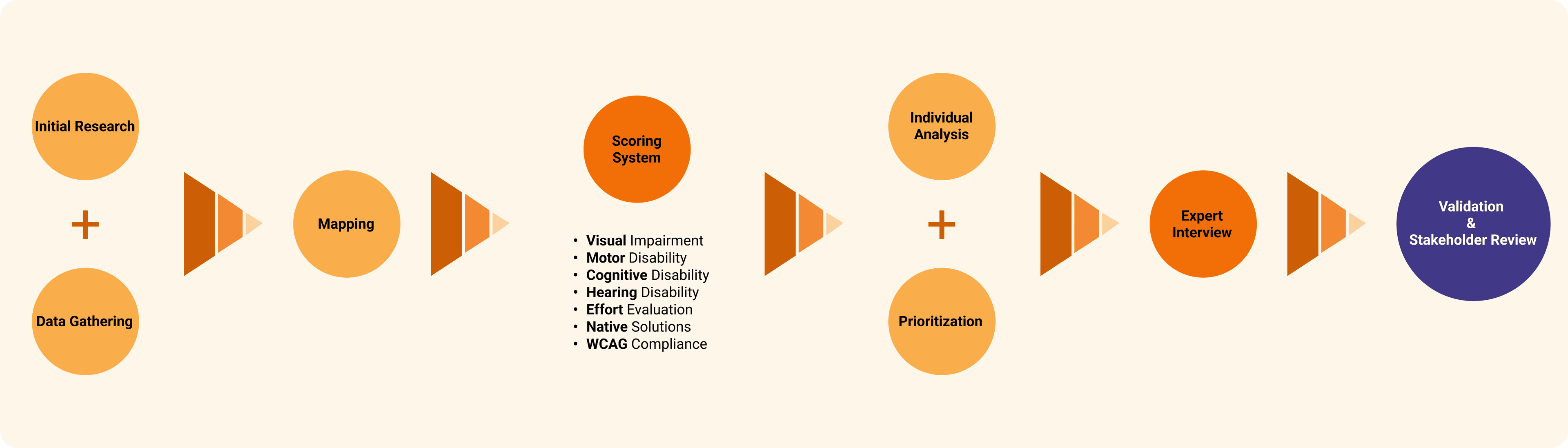
I created a multi-dimensional evaluation framework that went beyond simple feature comparison.
Mapping matrix
- Cataloged every accessibility feature across all five competitors
- Mapped each feature to specific WCAG 2.1 success criteria (A, AA, AAA levels)
- Identified target user groups for each functionality
Impact assessment
A scoring system that weighted user impact across disability types, to reflect the varying levels of friction users actually face online:
| Disability type | Weight | Rationale |
|---|---|---|
| Visual impairment | 3× | Largest user group affected by web accessibility |
| Motor disability | 2× | Significant navigation challenges online |
| Cognitive disability | 2× | Different needs across a broad range |
| Hearing disability | 1× | Smaller web-specific impact |
Impacted groups. We added +1 point per additional group benefiting from a solution, so features that serve several groups at once rise in the ranking.
Effort evaluation
We held a collaborative session with the full development team to align on effort levels and finalize the scoring model: low effort 1.0×, medium 0.75×, high 0.5×.
Competitive landscape
I documented 43 different accessibility features across all platforms, which revealed some significant patterns.
| Competitor | Total features | Unique features | WCAG A | WCAG AA | WCAG AAA |
|---|---|---|---|---|---|
| C1 | 28 | 8 | 15 | 18 | 12 |
| C2 | 16 | 2 | 9 | 12 | 8 |
| C3 | 18 | 3 | 10 | 13 | 9 |
| C5 | 17 | 2 | 9 | 12 | 10 |
| C4 | 13 | 0 | 7 | 9 | 6 |
Initial insights: WCAG compliance gaps
Despite accessibility being the core value proposition:
- Only 60% of features properly addressed WCAG Level A requirements
- Most competitors focused on Level AAA enhancements while missing Level A fundamentals
Prioritization
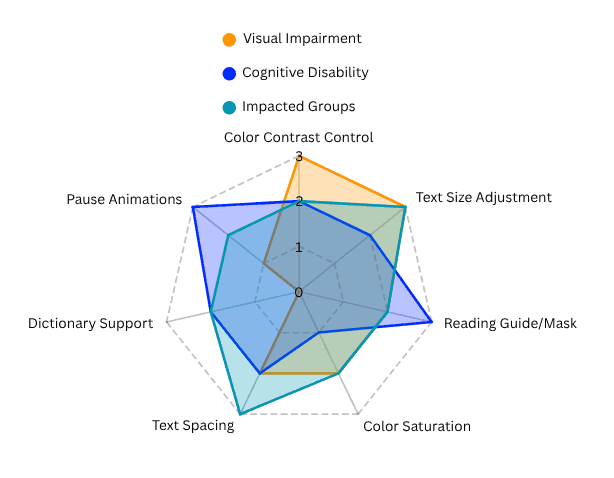
Based on the research findings and strategic considerations, the team prioritized seven core features for implementation.
Text description of this chart
Colour contrast control scores highest for visual impairment (3). Text size adjustment scores high on all three series. Reading guide/mask and pause animations peak on cognitive disability. Text spacing scores highest on impacted groups. Dictionary support scores lowest overall but is retained as an AI differentiator.
The seven features
| Feature | WCAG level | Why it made the list |
|---|---|---|
| Color contrast control | A / AA / AAA | User-selectable colors for readability. WCAG 1.4.8. Helps low vision, colour blindness, dyslexia. |
| Text size adjustment | AA | Enlargement to 200% without breaking layout. WCAG 1.4.4 and 1.4.8. |
| Reading guide / mask | None | Highlights one line at a time. Not a WCAG requirement, but strong for ADHD and dyslexia. |
| Color saturation | AA | Reduces overly vivid colour that causes visual discomfort. Supports WCAG 1.4.11. |
| Text spacing | AA | Customisable line, word and letter spacing. WCAG 1.4.12. |
| Dictionary / glossary | AAA | AI-powered inline definitions for unusual words. WCAG 3.1.3. |
| Pause animations | A | Stop or pause motion over 5 seconds. WCAG 2.2.2, for vestibular and cognitive load. |
Results & impact
The research provided the strategic clarity needed for Hand Talk's B2B market entry. All seven recommended features were incorporated into the 2024 product roadmap.
43 → 7
Features benchmarked, then prioritized for the roadmap
3 categories
Font controls, navigation support, colour controls
A → AAA
Full alignment across WCAG conformance levels
Clear differentiation was established through strategic feature selection, AI-powered enhancements like dictionary support, and the Libras and ASL avatars, which no competitor could match.
On the business side: a successful B2B market reentry, and a foundation for future AI-powered accessibility innovations. Sorenson subsequently announced its acquisition of Hand Talk to develop automated sign language translation capabilities.
Lessons learned
A clear, structured evaluation kept the process fair and reduced bias, and scoring features by their impact across different disabilities gave a realistic sense of what truly benefits users.
Involving real users earlier would have provided deeper insight into their actual needs and pain points.
Meeting WCAG guidelines is essential, but how well you apply them is what really matters. And understanding the unique market context, like the importance of Libras support in Brazil, opens up valuable opportunities that a feature-parity comparison would miss entirely.
Other projects.
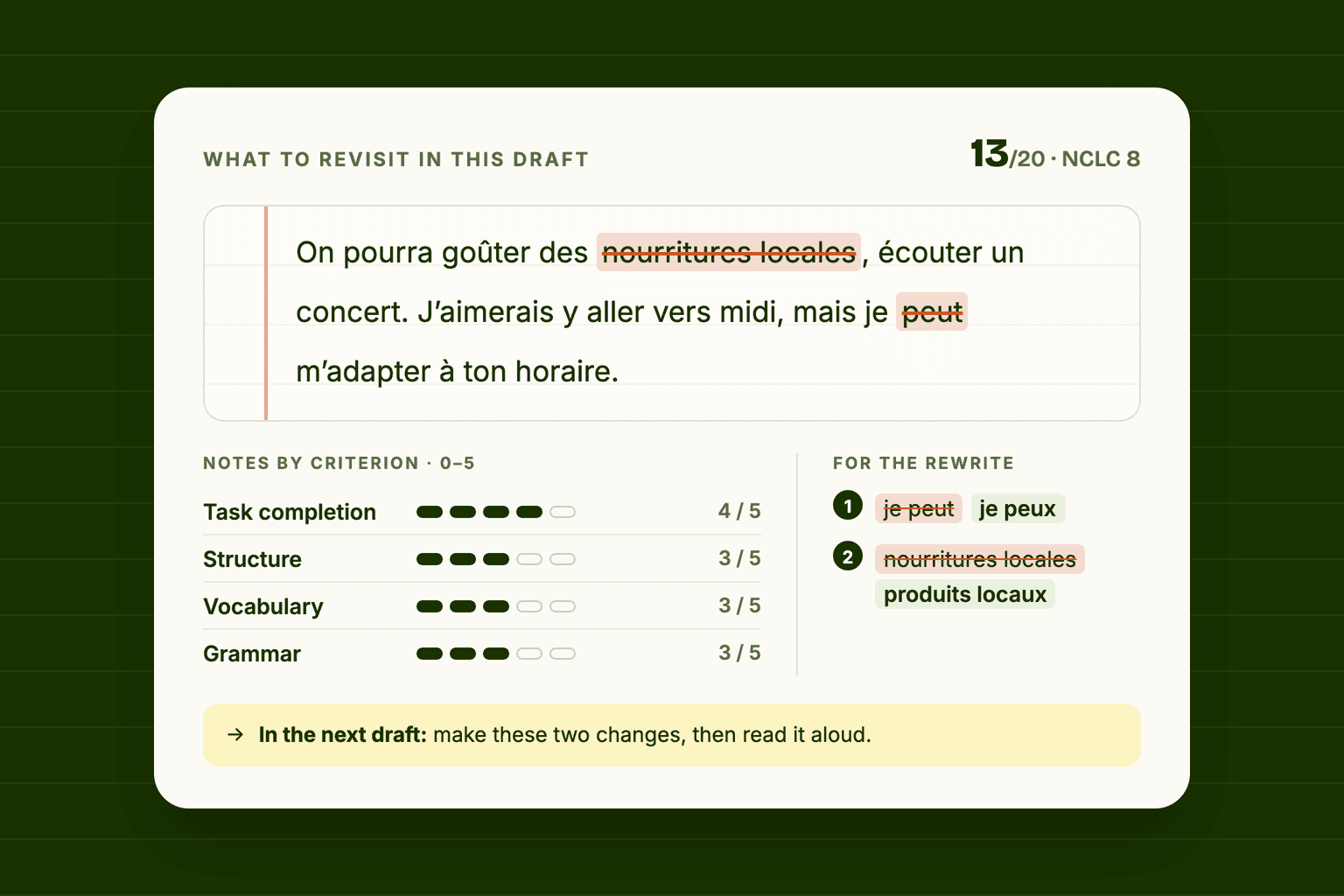
Écrivance · Nov 2025 – Present
Turning AI Feedback Into a Learning Interface
A language model will happily write four paragraphs about your French essay. None of that is a lesson. This is how I turned model output into a scored, prioritised, act-on-it-now page, for an exam I was sitting myself.
293,849 words written and corrected through the interface
- AI Interaction Design
- Product Design
- Design Systems
Hand Talk · Q4 2022
Why 94% of Our Leads Were Wrong
A UX investigation into disqualified leads revealed an unexpected behaviour pattern, and one redirect fixed everything.
94% → 0% disqualified leads from the plugin loading screen
- UX Research
- Behavioral Analysis
- Optimization

Hand Talk · May – July 2022
Translation Evaluation Impact Analysis
Measuring what an accessibility-led redesign of Hand Talk's evaluation screen actually changed. Evaluations rose 93.30%, and they rose while the audience shrank.
+93.30% increase in completed translation evaluations
- UX Research
- Accessibility
- Data Analysis
Hand Talk · 2022–2023
Making an Accessibility Product Measurable
Mapping 11 flows and 53 trackable states for an accessibility plugin, and building the measurement layer every later study here runs on.
11 flows mapped into 53 trackable interactions and states
- Product Analytics
- Measurement Design
- User Flows